
LET THERE BE LIGHT" Ministries

SCENARIO OF EVENTS BEFORE, DURING AND AFTER
THE SUNDAY LAW, part 10 quotes
1) Event #26 – The memory of sin, sinners and the former wicked earth is erased from the minds of the Redeemed, and God recreates the earth and heaven new.
“And he that sat upon the throne said, Behold, I make all things new....And I saw a new heaven and a new earth: for the first heaven and the first earth were passed away; and there was no more sea....And God shall wipe away all tears from their eyes; and there shall be no more death, neither sorrow, nor crying, neither shall there be any more pain: for the former things are passed away.” Revelation 21:5, 1, 4.
“...the former troubles are forgotten, and because they are hid from mine eyes. For, behold, I create new heavens and a new earth: and the former shall not be remembered, nor come into mind. But be ye glad and rejoice for ever in that which I create: for, behold, I create Jerusalem a rejoicing, and her people a joy. And I will rejoice in Jerusalem, and joy in my people: and the voice of weeping shall be no more heard in her, nor the voice of crying.” Isaiah 65:16-19.
“The wolf also shall dwell with the lamb, and the leopard shall lie down with the kid; and the calf and the young lion and the fatling together; and a little child shall lead them. And the cow and the bear shall feed; their young ones shall lie down together: and the lion shall eat straw like the ox. And the sucking child shall play on the hole of the asp, and the weaned child shall put his hand on the cockatrice' den. They shall not hurt nor destroy in all my holy mountain”. Isaiah 11:6-9.
“The fire that consumes the wicked purifies the earth. Every trace of the curse is swept away. No eternally burning hell will keep before the ransomed the fearful consequences of sin.
“One reminder alone remains: Our Redeemer will ever bear the marks of His crucifixion. Upon His wounded head, upon His side, His hands and feet, are the only traces of the cruel work that sin has wrought. Says the prophet, beholding Christ in His glory: "He had bright beams coming out of His side: and there was the hiding of His power." Habakkuk 3:4, margin. That pierced side whence flowed the crimson stream that reconciled man to God--there is the Saviour's glory, there "the hiding of His power." "Mighty to save," through the sacrifice of redemption, He was therefore strong to execute justice upon them that despised God's mercy. And the tokens of His humiliation are His highest honor; through the eternal ages the wounds of Calvary will show forth His praise and declare His power.” Great Controversy, p 674.
“The same fire from God that consumed the wicked purified the whole earth. The broken, ragged mountains melted with fervent heat, the atmosphere also, and all the stubble was consumed. Then our inheritance opened before us, glorious and beautiful, and we inherited the whole earth made new. We all shouted with a loud voice, ‘Glory; Alleluia!’“ Early Writings, p 54.
“In the Bible the inheritance of the saved is called "a country." Hebrews 11:14-16. There the heavenly Shepherd leads His flock to fountains of living waters. The tree of life yields its fruit every month, and the leaves of the tree are for the service of the nations. There are ever-flowing streams, clear as crystal, and beside them waving trees cast their shadows upon the paths prepared for the ransomed of the Lord. There the wide-spreading plains swell into hills of beauty, and the mountains of God rear their lofty summits. On those peaceful plains, beside those living streams, God's people, so long pilgrims and wanderers, shall find a home.” Great Controversy, p 675.
2) Event #27 – God and His kingdom and City of the New Jerusalem forever dwells on the New earth; and Christ then serves the marriage supper to all the redeemed.
“And I John saw the holy city, new Jerusalem...And I heard a great voice out of heaven saying, Behold, the tabernacle of God is with men, and he will dwell with them, and they shall be his people, and God himself shall be with them, and be their God.” Revelation 21:2-3.
“And he...showed me that great city, the holy Jerusalem...Having the glory of God: and her light was like unto a stone most precious, even like a jasper stone, clear as crystal; And had a wall great and high, and had twelve gates, and at the gates twelve angels, and names written thereon, which are the names of the twelve tribes of the children of Israel: On the east three gates; on the north three gates; on the south three gates; and on the west three gates. And the wall of the city had twelve foundations, and in them the names of the twelve apostles of the Lamb. And he that talked with me had a golden reed to measure the city, and the gates thereof, and the wall thereof. And the city lieth foursquare, and the length is as large as the breadth: and he measured the city with the reed, twelve thousand furlongs. The length and the breadth and the height of it are equal. And he measured the wall thereof, an hundred and forty and four cubits, according to the measure of a man, that is, of the angel.
“And the building of the wall of it was of jasper: and the city was pure gold, like unto clear glass. And the foundations of the wall of the city were garnished with all manner of precious stones. The first foundation was jasper; the second, sapphire; the third, a chalcedony; the fourth, an emerald; The fifth, sardonyx; the sixth, sardius; the seventh, chrysolyte; the eighth, beryl; the ninth, a topaz; the tenth, a chrysoprasus; the eleventh, a jacinth; the twelfth, an amethyst. And the twelve gates were twelve pearls: every several gate was of one pearl: and the street of the city was pure gold, as it were transparent glass.
“And I saw no temple therein: for the Lord God Almighty and the Lamb are the temple of it. And the city had no need of the sun, neither of the moon, to shine in it: for the glory of God did lighten it, and the Lamb is the light thereof. And the nations of them which are saved shall walk in the light of it: and the kings of the earth do bring their glory and honour into it. And the gates of it shall not be shut at all by day: for there shall be no night there. And they shall bring the glory and honour of the nations into it. And there shall in no wise enter into it any thing that defileth, neither whatsoever worketh abomination, or maketh a lie: but they which are written in the Lamb's book of life.
“And he showed me a pure river of water of life, clear as crystal, proceeding out of the throne of God and of the Lamb. In the midst of the street of it, and on either side of the river, was there the tree of life, which bare twelve manner of fruits, and yielded her fruit every month: and the leaves of the tree were for the healing of the nations. And there shall be no more curse: but the throne of God and of the Lamb shall be in it; and his servants shall serve him: And they shall see his face; and his name shall be in their foreheads. And there shall be no night there; and they need no candle, neither light of the sun; for the Lord God giveth them light: and they shall reign for ever and ever.” Revelation 21:10-27, 22:1-5.
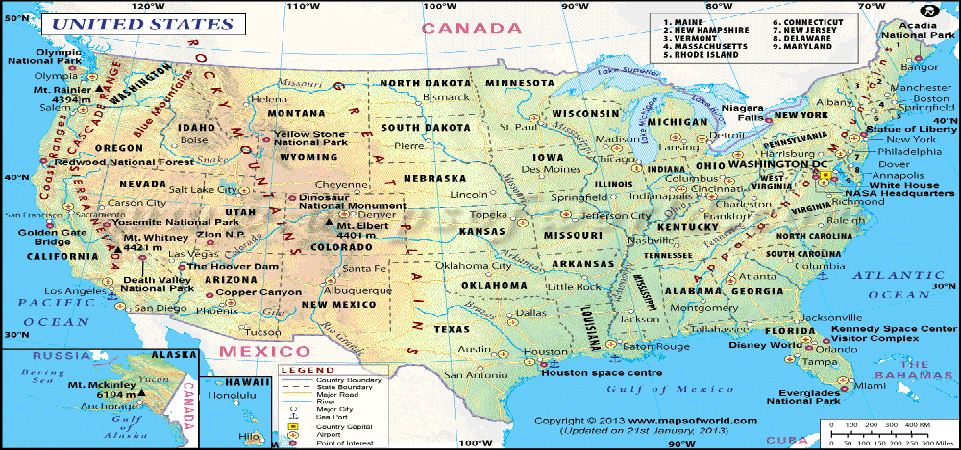
The size of the City of God was measured in furlongs, and a furlong back then was about 600 feet long today. As the city of God was measured to be 12,000 furlongs, then 12,000 furlongs times 600 feet would equal over 1360 miles long. The city was also foursquare with the length the same as its breadth. This means that the city of God is over 1360 miles long, and 1360 miles wide, encompassing over 1.8 million square miles! The state of California encompasses about 164,000 square miles, and since the city of God has 1.8 million square miles, then it has the equivalent of 11 states of California put together within it. Or since the contiguous United States of America is about 3.2 million square miles, then the New Jerusalem is massive enough to cover over half of the US!
The thickness of the walls of the New Jerusalem were measured in cubits, and a cubit back then was about 18 inches or 1.5 feet today. As the walls of the city of God are 144 cubits thick, then 144 cubits times 1.5 feet, equals 216 feet thick!
But we were also told that the length and the breadth and the height of the city of God are equal, thus making it like a cube. As the length and width of the city is 1360 miles, then it’s walls are 1360 miles high! The New Jerusalem is massive, containing a total volume of more than 2.5 billion cubic miles within its 4 walls!
“There is the New Jerusalem, the metropolis of the glorified new earth, "a crown of glory in the hand of the Lord, and a royal diadem in the hand of thy God." "Her light was like unto a stone most precious, even like a jasper stone, clear as crystal." "The nations of them which are saved shall walk in the light of it: and the kings of the earth do bring their glory and honor into it." Saith the Lord: "I will rejoice in Jerusalem, and joy in My people." "The tabernacle of God is with men, and He will dwell with them, and they shall be His people, and God Himself shall be with them, and be their God." Isaiah 62:3; Revelation 21:11, 24; Isaiah 65:19; Revelation 21:3.
“In the City of God "there shall be no night." None will need or desire repose. There will be no weariness in doing the will of God and offering praise to His name. We shall ever feel the freshness of the morning and shall ever be far from its close. "And they need no candle, neither light of the sun; for the Lord God giveth them light." Revelation 22:5. The light of the sun will be superseded by a radiance which is not painfully dazzling, yet which immeasurably surpasses the brightness of our noontide. The glory of God and the Lamb floods the Holy City with unfading light. The redeemed walk in the sunless glory of perpetual day.
“‘I saw no temple therein: for the Lord God Almighty and the Lamb are the temple of it.’ Revelation 21:22. The people of God are privileged to hold open communion with the Father and the Son. "Now we see through a glass, darkly." 1 Corinthians 13:12. We behold the image of God reflected, as in a mirror, in the works of nature and in His dealings with men; but then we shall see Him face to face, without a dimming veil between. We shall stand in His presence and behold the glory of His countenance.” Great Controversy, p 676-677.
“The faithful will be invited in to the marriage supper of the Lamb, and Christ will gird himself, and come forth to serve them.” Review and Herald, March 7, 1893 par 7.
“Soon we heard His (Jesus’) lovely voice again, saying, "Come, My people, you have come out of great tribulation, and done My will; suffered for Me; come in to supper, for I will gird Myself, and serve you." We shouted, "Alleluia! glory!" and entered into the city. And I saw a table of pure silver; it was many miles in length, yet our eyes could extend over it. I saw the fruit of the tree of life, the manna, almonds, figs, pomegranates, grapes, and many other kinds of fruit.” Early Writings, p 19.
3) Event #28 – Redeemed saints enjoy the beauties of the new earth, and even though each has a mansion Christ has personally built just for them, yet each will also build homes on their own piece of land on the new earth.
“In my Father's house are many mansions: if it were not so, I would have told you. I go to prepare a place for you. And if I go and prepare a place for you, I will come again, and receive you unto myself; that where I am, there ye may be also.” John 14:2-3.
“They shall build houses, and inhabit them; and they shall plant vineyards, and eat the fruit of them. They shall not build, and another inhabit; they shall not plant, and another eat: for as the days of a tree are the days of my people, and mine elect shall long enjoy the work of their hands.” Isaiah 65:21-22.
“There will be employment in Heaven. The redeemed state is not one of idle repose.
“In the earth made new, the redeemed will engage in the occupations and pleasures that brought happiness to Adam and Eve in the beginning.” God’s Amazing Grace, p 362.
“In the earth made new, the redeemed will engage in the occupations and pleasures that brought happiness to Adam and Eve in the beginning. The Eden life will be lived, the life in garden and field.” Prophets and Kings, p 730-731.
“In this garden the Lord placed trees of every variety for usefulness and beauty. There were trees laden with luxuriant fruit, of rich fragrance, beautiful to the eye, and pleasant to the taste, designed of God to be food for the holy pair. There were the lovely vines which grew upright, laden with their burden of fruit, unlike anything man has seen since the fall. The fruit was very large, and of different colors; some nearly black, some purple, red, pink, and light green. This beautiful and luxuriant growth of fruit upon the branches of the vine was called grapes. And it was the happy labor of Adam and Eve to form beautiful bowers from the branches of the vine, and train them, forming dwellings of nature's beautiful, living trees and foliage, laden with fragrant fruit.” Signs of the Times, January 9, 1879 par 15.
“Then we began to look at the glorious things outside of the city. There I saw most glorious houses, that had the appearance of silver, supported by four pillars set with pearls most glorious to behold. These were to be inhabited by the saints. In each was a golden shelf. I saw many of the saints go into the houses, take off their glittering crowns and lay them on the shelf, then go out into the field by the houses to do something with the earth; not as we have to do with the earth here; no, no. A glorious light shone all about their heads, and they were continually shouting and offering praises to God.
“I saw another field full of all kinds of flowers, and as I plucked them, I cried out, "They will never fade." Next I saw a field of tall grass, most glorious to behold; it was living green and had a reflection of silver and gold, as it waved proudly to the glory of King Jesus. Then we entered a field full of all kinds of beasts--the lion, the lamb, the leopard, and the wolf, all together in perfect union. We passed through the midst of them, and they followed on peaceably after. Then we entered a wood, not like the dark woods we have here; no, no; but light, and all over glorious; the branches of the trees moved to and fro, and we all cried out, "We will dwell safely in the wilderness and sleep in the woods." We passed through the woods, for we were on our way to Mount Zion....
“Mount Zion was just before us, and on the mount was a glorious temple, and about it were seven other mountains, on which grew roses and lilies. And I saw the little ones climb, or, if they chose, use their little wings and fly, to the top of the mountains and pluck the never-fading flowers. There were all kinds of trees around the temple to beautify the place: the box, the pine, the fir, the oil, the myrtle, the pomegranate, and the fig tree bowed down with the weight of its timely figs--these made the place all over glorious.” Early Writings, p 17-19.
4) Event #29 – The 144,000 minister before God and Christ in the heavenly sanctuary on Mount Zion, and forever follow the Lamb withersoever He goeth.
“And I heard the number of them which were sealed: and there were sealed an hundred and forty and four thousand of all the tribes of the children of Israel. Of the tribe of Juda [were] sealed twelve thousand. Of the tribe of Reuben...Gad...Aser...Nephthalim...Manasses...Simeon...Levi...Issachar... Zabulon...Joseph...and Benjamin were sealed twelve thousand....These are they which came out of great tribulation, and have washed their robes, and made them white in the blood of the Lamb. Therefore are they before the throne of God, and serve him day and night in his temple: and he that sitteth on the throne shall dwell among them." Revelation 7:4-8, 14-15.
“And I looked, and, lo, a Lamb stood on the mount Sion, and with him an hundred forty and four thousand, having his Father's name written in their foreheads. And I heard a voice from heaven, as the voice of many waters, and as the voice of a great thunder: and I heard the voice of harpers harping with their harps: And they sung as it were a new song before the throne, and before the four beasts, and the elders: and no man could learn that song but the hundred and forty and four thousand, which were redeemed from the earth. These are they which were not defiled with women; for they are virgins. These are they which follow the Lamb whithersoever he goeth. These were redeemed from among men, being the firstfruits unto God and to the Lamb. And in their mouth was found no guile: for they are without fault before the throne of God.” Revelation 14:1-5.
“John saw a Lamb on Mount Zion, and with him 144,000, having his Father's name written in their foreheads. They bore the signet of heaven. They reflected the image of God. They were full of the light and the glory of the Holy One.” Review and Herald, March 19, 1889 par 6.
“...the company that have “gotten the victory over the beast, and over his image, and over his mark, and over the number of his name.” With the Lamb upon Mount Zion, “having the harps of God,” they stand, the hundred and forty and four thousand that were redeemed from among men; and there is heard, as the sound of many waters, and as the sound of a great thunder, “the voice of harpers harping with their harps.” And they sing “a new song” before the throne, a song which no man can learn save the hundred and forty and four thousand. It is the song of Moses and the Lamb—a song of deliverance. None but the hundred and forty-four thousand can learn that song; for it is the song of their experience—an experience such as no other company have ever had. “These are they which follow the Lamb whithersoever He goeth.” These, having been translated from the earth, from among the living, are counted as “the first fruits unto God and to the Lamb.” Revelation 15:2, 3; 14:1-5.” Great Controversy, p 648-649.
“And as we were about to enter the holy temple, Jesus raised His lovely voice and said, "Only the 144,000 enter this place," and we shouted, "Alleluia."
“This temple was supported by seven pillars, all of transparent gold, set with pearls most glorious. The wonderful things I there saw I cannot describe. Oh, that I could talk in the language of Canaan, then could I tell a little of the glory of the better world. I saw there tables of stone in which the names of the 144,000 were engraved in letters of gold.” Early Writings, p 18.
“In His temple doth everyone speak of His glory” (Psalm 29:9), and the song which the ransomed ones will sing—the song of their experience—will declare the glory of God: “Great and marvelous are Thy works, O Lord God, the Almighty; righteous and true are Thy ways, Thou King of the ages. Who shall not fear, O Lord, and glorify Thy name? For Thou only art holy.” Revelation 15:3, 4.” Education, p 308-309.